The Day the Sea Taught Me What It Truly Means to Be a Nurse
 xs462828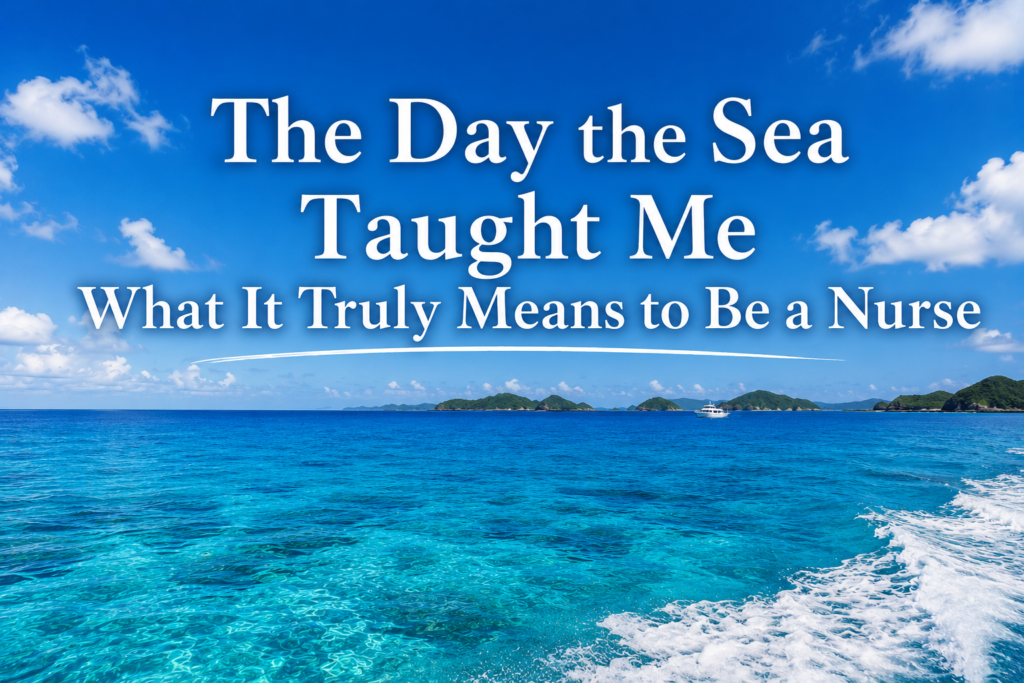
Every year, when Marine Day arrives in Japan, I find myself thinking about one unforgettable day.
It happened about seven years ago, in the crystal-clear waters of the Kerama Islands off Okinawa.
Ironically, I've never been comfortable with the sea.
As a child, I had an active imagination. Whenever I stepped into the ocean, I was convinced that some mysterious creature from the deep would suddenly appear and pull me under.
It sounds funny now, but back then, I truly believed it.
So for most of my life, I kept my distance from the ocean.
Then, in my fifties, something unexpected happened.
The clinic where I worked as a nurse organized a staff trip to Okinawa. Our director was an enthusiastic scuba diver, and the destination was the famous Kerama Islands, known for some of Japan's clearest waters.
At that point in my life, I had begun telling myself something new:
"If there's something you want to try, do it while you still can."
So, without thinking too much, I announced,
"I'll try scuba diving too."
The night before, we enjoyed Okinawan food and awamori, the local rice spirit.
The next morning, I felt perfectly fine and even ate a full breakfast before boarding the boat.
That turned out to be a mistake.
The high-speed boat bounced across the waves, and I became spectacularly seasick.
By the time we reached the islands, my breakfast had long since returned to the sea, and I could barely stand.
We began with snorkeling.
The water was astonishingly clear.
I could see all the way to the seabed, far below.
Most people would call it beautiful.
To me, it was terrifying.
The endless blue world stretched beneath me, gently swaying with the waves.
I held tightly to the instructor's hand the entire time.
When everyone else prepared for scuba diving, I quietly declined and stayed on the boat with the captain.
As I sat there watching the brilliant blue sea meet the equally blue sky, my seasickness finally began to ease.
Then everything changed.
A desperate shout came from the stern.
"Help us! Pull him up!"
I ran toward the voice.
A diver was calling from the water.
Beside him floated another man, face up, still wearing his wetsuit.
The moment I saw his face, I knew.
He wasn't breathing.
We tried to lift him onto the boat, but a large body wrapped in a water-soaked wetsuit is far heavier than most people imagine.
The captain and I struggled together until we finally managed to pull him aboard.
He had no pulse that we could detect.
No visible breathing.
No response.
There were only three of us on the boat—the captain, the diver who had brought him up, and me.
Without hesitation, I began chest compressions.
Each compression forced seawater from his airway.
Time seemed strangely slow.
Over and over, I found myself thinking,
"Doctor... please come back soon."
Eventually, our clinic director and another nurse surfaced from their dive.
The captain brought the AED and oxygen equipment, and together we continued resuscitation.
Then...
He took a breath.
A small one.
Then another.
He had started breathing on his own.
The moment I realized it, every ounce of strength left my body.
I simply sat down on the deck.
A rescue helicopter soon arrived and flew him to the hospital.
The others eventually returned to diving.
I stayed exactly where I was—on the boat.
Strangely enough, the seasickness that had made me miserable all morning had completely disappeared.
Well...
Until the boat ride back.
I was thoroughly seasick again.
Some things never change.
A few days later, the diving shop contacted our clinic.
The man had survived and made a full recovery.
His family wanted to meet us to express their gratitude.
Our director politely declined, saying,
"We are simply people who happened to be there."
I remember smiling to myself.
"Well... I was the one doing chest compressions the longest," I thought.
Still, I sometimes wonder what he looked like after he recovered.
The only face I remember is the pale one lying on that boat.
The next day, I developed severe sciatica.
During the rescue, I hadn't noticed how much strain my body had endured from lifting a heavy man aboard and performing continuous CPR.
Perhaps extraordinary strength really does appear when someone needs help.
Even now, years later, I'm still not particularly fond of the sea.
But whenever I see photographs of the Kerama Islands, I don't first remember the seasickness.
Or the diving.
I remember that, on one quiet boat floating in an endless blue sea, a life continued.
And I remember something else.
Long before that day, nursing had already become part of who I was.
When the moment came, I didn't stop to think about what I should do.
My hands simply knew.
Sometimes, the work we devote ourselves to leaves marks deeper than we realize.
Not only on our skills—
but quietly, on our hearts.