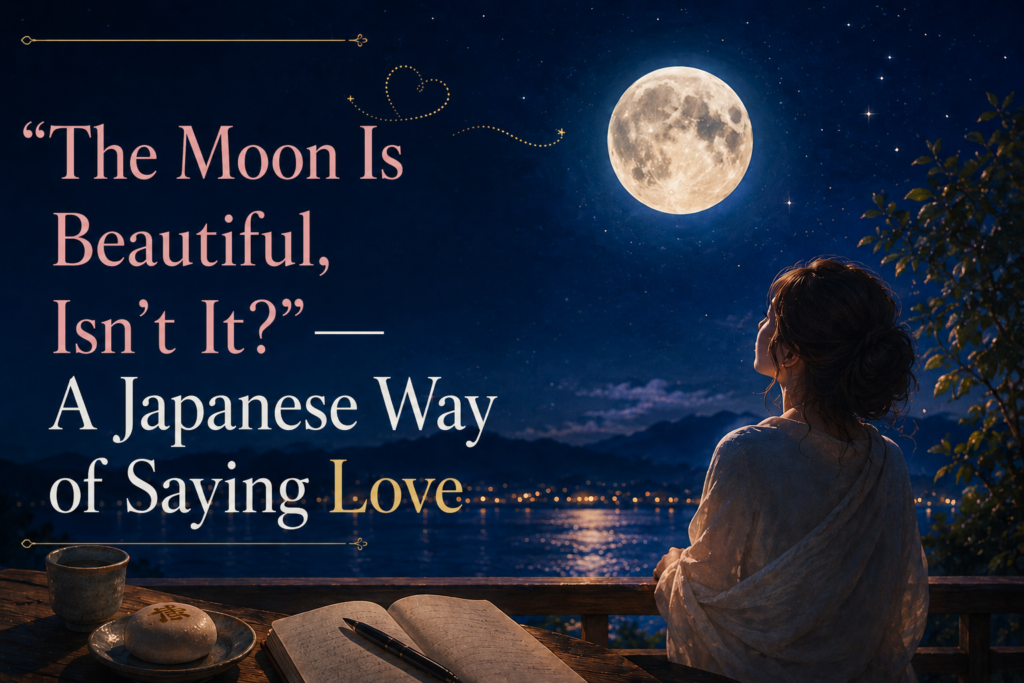
I LOVE YOU = "The Moon Is Beautiful" — Is That Really True?
 xs462828
When writing about the Japanese calendar and seasonal traditions,
I often find myself talking about the moon.
Tonight, I wanted to share one of those small stories
that quietly lingers in Japanese culture.
■ The Story
There is a famous saying in Japan:
"Instead of translating 'I love you' directly,
Natsume Sōseki said it should be translated as
'The moon is beautiful, isn't it?'"
Natsume Sōseki was one of Japan's most beloved novelists
from the Meiji era, over a hundred years ago.
According to the story, one of his students translated
"I love you" too literally during an English lesson.
Sōseki supposedly replied:
"Japanese people do not express love so directly.
Say, 'The moon is beautiful,' instead."
For many years, I thought this story was wonderfully romantic.
But apparently, there is no solid historical evidence
that Sōseki ever actually said it.
In other words — it may simply be a modern legend.
When I first learned that, I laughed and thought:
Wait… really?
■ Why the Story Lives On
And yet, even if the story isn't true,
people in Japan continue to love it.
Maybe because it expresses something
many people still recognize deep down.
Not saying "I love you" aloud.
Simply standing beneath the same moon
and sharing an unspoken feeling.
There is a certain quietness in Japanese communication —
a beauty in what is left unsaid.
Before smartphones and instant messages existed,
people spent more time wondering:
Is that person looking at the same moon tonight?
Perhaps love once had more room for imagination.
Modern life moves so quickly now
that this feeling can seem distant.
We are surrounded by information,
constant notifications, endless conversations.
But the moon remains strangely unchanged.
Of course, if I'm being honest —
when I look at the moon these days,
I'm more likely to think about sweets than romance.
A round moon tends to remind me of traditional Japanese buns
before poetry ever enters my mind.
So maybe I'm not the ideal person to talk about romance after all.
■ The First Quarter Moon
Tomorrow, May 23rd, marks the First Quarter Moon —
a rhythm still quietly woven into Japanese seasonal awareness.
Traditionally, it is seen as a good moment
to begin moving forward with intentions set during the new moon.
Nothing dramatic is necessary.
Tonight, perhaps put your phone down for a little while.
Step outside for a moment and look up at the sky.
You do not need to think deeply about anything.
Just look at the moon.
Let the noise of everyday life loosen its grip for a few minutes.
Sometimes, that alone is enough
to gently settle the heart.
And while looking at the same moon —
who comes to your mind?