The Red-Nosed Princess Who Quietly Won in the End— The Season of Safflowers in Japan —
 xs462828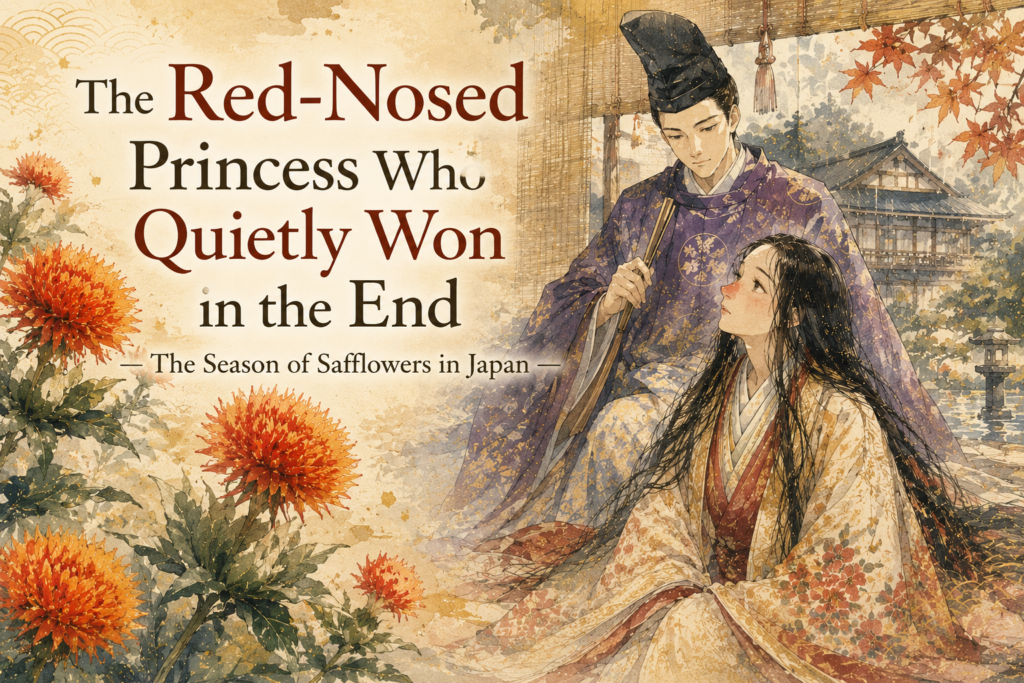
On May 26, Japan's traditional seasonal calendar moves into a micro-season
called Benibana Sakau — "Safflowers Bloom."
It is the time of year when safflowers begin opening across the fields,
their vivid red-orange petals glowing softly under the early summer sun.
In Japan, safflowers have another old name:
Suetsumuhana.
And for many Japanese people, that name immediately brings to mind
a rather unforgettable woman from The Tale of Genji,
a classic novel written over a thousand years ago.
——
When I was in middle school, I loved shōjo manga.
One series I adored was Asaki Yumemishi,
a beautifully illustrated retelling of The Tale of Genji.
Through those pages, I first encountered the elegant and complicated world
of aristocratic romance in ancient Kyoto.
Prince Genji — the story's impossibly charming hero —
falls in love with many beautiful women.
But among them, there is one woman who feels strangely out of place.
Her name is Suetsumuhana.
——
Her appearance is described in a way that still surprises readers today.
She is said to have:
· a long red nose
· a thin and awkward figure
· unusually beautiful hair
· and almost no social grace at all
When Genji first sees her clearly in daylight,
you can almost imagine his silent panic:
"Oh… this is not what I expected."
And yet, instead of disappearing from the story, she remains.
Perhaps because Genji begins to feel something unexpected toward her —
responsibility, sympathy,
or maybe affection born from bewilderment.
——
What makes Suetsumuhana memorable is not beauty or charm.
It is her complete lack of sophistication.
Genji sends her elegant robes and poetic love letters,
the Heian-era equivalent of:
"I saw this and thought of you. Wear it next time we meet."
Her reply?
A famously awkward poem that essentially repeats the word robe
over and over again, with almost painful sincerity.
Even now, Japanese readers laugh at the scene.
She completely misses the flirtation.
Completely misses the elegance.
And somehow, that honesty becomes strangely endearing.
——
Years later, Genji loses political power and leaves the capital.
His support for Suetsumuhana disappears.
Her mansion falls into ruin.
People urge her to forget him and move on.
But she does not.
Not because she is noble or dramatic.
Simply because she does not know how to become someone else.
So she waits.
Quietly. Stubbornly. Year after year.
——
Then one rainy night,
Genji happens to pass by her neglected house after returning to Kyoto.
The place is nearly abandoned, weathered like an old ghost story.
But inside, he finds Suetsumuhana —
still there, still waiting for him with unwavering devotion.
And for perhaps the first time in his life,
Genji feels ashamed of his own restlessness.
In the end, he welcomes her into his household
and ensures that she lives the remainder of her life
in peace and stability.
While many of the novel's dazzling beauties meet tragic endings,
Suetsumuhana — awkward, unfashionable, and entirely herself —
quietly becomes one of the happiest women in the story.
——
I think about her every year when the safflowers bloom.
Because this is not really a Cinderella story
about an "unattractive woman" suddenly winning love.
It is a story about someone who never learned how to bend herself
to fit the world —
and somehow found happiness precisely because of that.
——
As Japan enters the season of Benibana Sakau,
the safflowers begin to glow red at their tips.
And once you know the flower's old name — Suetsumuhana —
those small red petals begin to feel strangely lovable.
You do not have to be clever at navigating trends.
You do not have to become more polished to deserve peace.
Sometimes, quietly remaining yourself
is its own kind of strength.
And sometimes,
that quiet strength blooms much later than expected.