Shōman: An Old Japanese Calendar That Still Understands the Seasons
 xs462828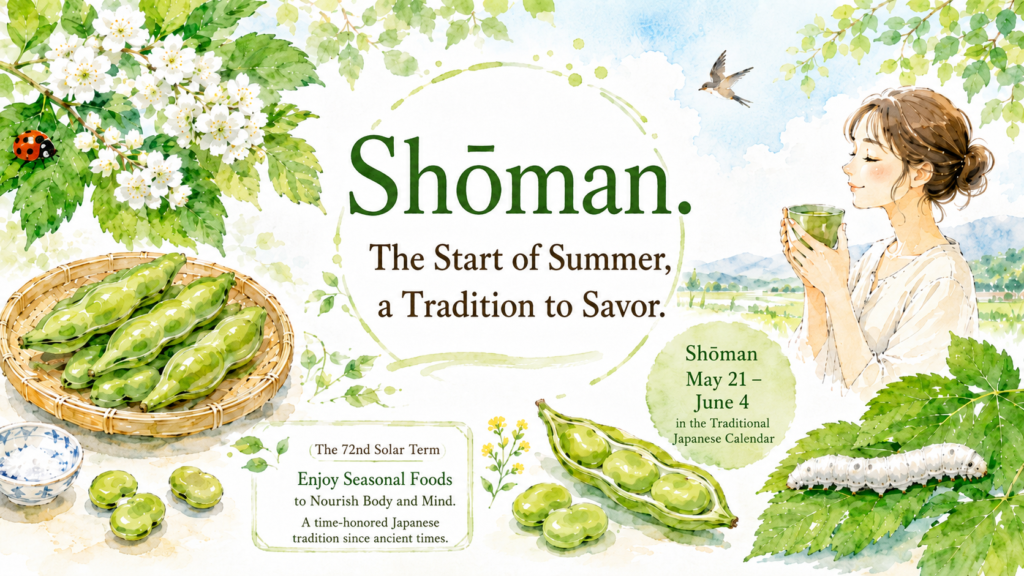
Small Fullness — The Old Calendar Still Works
On my way home, I stopped by the supermarket and found piles of fresh broad beans stacked near the entrance.
Without thinking, I picked some up.
At home, I boiled them quickly and sprinkled a little good salt on top.
Nothing fancy.
But seasonal food in Japan often tastes best that way — simple enough to let the season speak for itself.
Tomorrow, May 21st, marks Shōman in the traditional Japanese calendar.
Shōman (小満) is one of the 24 seasonal divisions known as Nijūshi Sekki,
an old calendar system brought from China and adapted to the rhythms of Japanese nature centuries ago.
The word literally means "small fullness."
Not full summer yet.
Not complete abundance.
Just the quiet moment when life begins to visibly swell and grow.
The broad beans pointing upward toward the sky feel like a perfect symbol of this season.
In fact, their Japanese name, soramame ("sky beans"), comes from the way the pods grow facing upward.
Still, there was something I had been wondering for years.
People say Shōman is a fresh and pleasant early summer season…
but honestly, hasn't Japan already become hot by late May?
Every year, summer seems to arrive earlier and more suddenly.
I had started to wonder whether the old seasonal calendar no longer matched modern life.
Then recently, I came across an interesting study by a climate researcher.
The paper explained that if seasonal terms like Shōman, Taisho (Great Heat), or Daikan (Great Cold)
are treated as only a single day, the temperatures do seem out of sync with Japan's actual climate.
But when each seasonal term is understood as a full fifteen-day period —
from the first day until the next seasonal marker —
the calendar still aligns remarkably well with Japan's natural changes.
In other words, the problem was not the calendar itself.
It was how people were using it.
Not: "Today is Shōman."
But rather: "From today, we enter the season of Shōman."
That small shift in perspective changed something for me.
The old calendar was never meant to capture a single perfect day.
It was designed to notice gradual transitions —
tiny movements in wind, plants, insects, rain, and light.
And somehow, that feels more human.
When I realized that this centuries-old calendar still quietly fits modern Japan,
I felt unexpectedly happy.
Of course, it is easy to focus only on climate change and how much the seasons have shifted.
But perhaps there is also value in slowing down enough to notice what still remains.
The sound of broad beans boiling in water.
Steam rising in the kitchen.
The soft sweetness after touching them lightly with salt.
Small things like these connect us back to the season.
Starting tomorrow, Japan also enters the micro-season called Kaiko Okite Kuwa wo Hamu —
"Silkworms Begin Eating Mulberry Leaves."
It is the time when silkworms busily feed on fresh mulberry leaves,
another quiet sign of early summer life.
Ladybugs appear more often now, too.
In gardens, along sidewalks, beside small roads —
seasonal signs are everywhere once you begin looking for them.
For the next fifteen days of Shōman, perhaps you might notice early summer a little more carefully.
Broad beans.
White deutzia flowers.
Warm wind moving through fresh green leaves.
Sometimes, simply saying to yourself —
"Today, Shōman begins."
— is enough to make everyday life look slightly different.