July 1: Why Mount Fuji Still Captures the Japanese Heart
 xs462828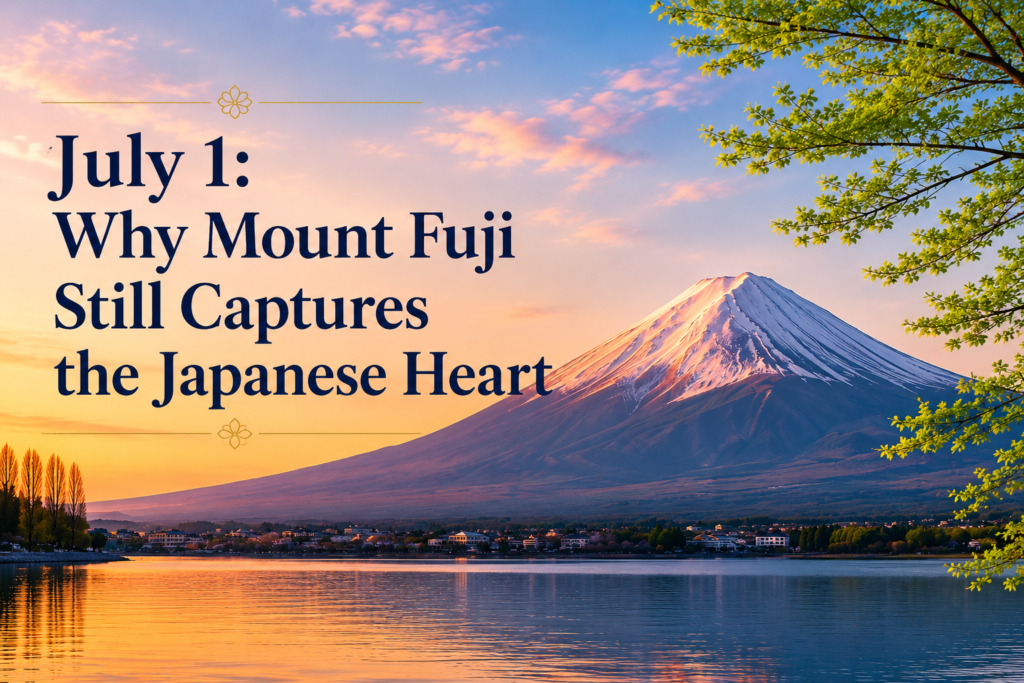
Every year on July 1, the climbing season opens on the Yamanashi side of Mount Fuji, Japan's highest and most iconic mountain.
Until I noticed it on a traditional Japanese calendar, I had never really thought about the phrase mountain opening. There is something quietly sacred about those words.
Interestingly, Mount Fuji has two official opening days.
The Yamanashi routes begin on July 1, while the Shizuoka side opens on July 10.
In both regions, local shrines hold ceremonies and festivals to pray for the safety of climbers before the season begins. Even today, these traditions remind people that climbing Fuji has long been more than a sporting challenge.
It's also an act of respect.
The Moment Everyone Reaches for Their Phone
I've never climbed Mount Fuji.
Yet whenever I'm on a bullet train or an airplane and someone says,
"Mount Fuji will soon be visible,"
I instinctively reach for my phone.
Like so many people in Japan, I want to capture the moment.
But when I look at the photo afterward, I often laugh.
"Was it really that small?"
No picture seems able to hold what my eyes just experienced.
The mountain's scale, its quiet presence, the feeling of seeing it rise above everything else—those things never quite fit inside a screen.
Perhaps some landscapes are simply meant to be remembered instead of photographed.
So Familiar, Yet Completely Different
We see Mount Fuji everywhere.
It's on television, in paintings, on postcards, and in travel guides. Around the world, it has become one of the symbols of Japan.
And yet, standing before the real mountain feels entirely different.
Calling it "big" doesn't come close.
Its graceful shape fills the horizon in a way that's difficult to describe. It doesn't simply stand in the landscape—it seems to shape the landscape around it.
Without thinking, I find myself looking up.
"So this is Mount Fuji."
That's all that comes to mind.
A Mountain Once Worshipped as a Living Presence
For centuries, people in Japan did not think of Mount Fuji as just another mountain.
It was believed to be the dwelling place of Asama Ōkami, the deity enshrined at the many Asama Shrines found around Fuji. The mountain itself was regarded as sacred.
Climbing toward its summit was once seen as drawing closer to the world of the gods.
Mount Fuji is also an active volcano.
In earlier times, eruptions inspired not only fear but reverence. People prayed for the mountain to remain peaceful, for good harvests, and for the well-being of the country.
Generation after generation, those prayers quietly accumulated around the mountain.
A Mountain Between Earth and Sky
In ancient Japan, mountains were often seen as places where heaven and earth met.
Among them, Mount Fuji has always stood apart.
Its nearly perfect cone.
Its towering height.
The way it disappears into clouds and then quietly emerges again.
Perhaps this is why it has long felt like a bridge between the human world and something beyond it.
Even today, many Japanese people straighten their posture when they catch sight of Fuji.
We may not always know why.
But perhaps somewhere deep within us remains a memory—not our own, but one passed down through generations—that this mountain deserves quiet respect.
Looking Forward to Seeing It Again
While learning about the opening of the climbing season, I found myself wanting to visit Mount Fuji again.
Not necessarily to climb it.
Simply to see it.
From the Shizuoka side.
From the Yamanashi side.
People say the mountain wears a different expression depending on where you stand.
That feels like a good reason to return.
And when I do, I'll probably raise my phone once again.
Then, after a moment, I'll lower it.
Because some memories become clearer when they are kept not in a photograph, but in our own hearts.