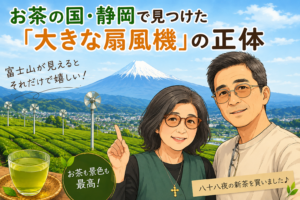
The Mystery of the Giant Fans in Shizuoka’s Tea Fields
 xs462828
Shizuoka is often called Japan’s tea country.
If you ask people what comes to mind when they hear the name Shizuoka, many will probably answer, “green tea.”
I certainly would have.
For years, my image of Shizuoka came from train windows. Whenever I traveled toward Tokyo on the Shinkansen, I would catch glimpses of endless tea fields and think,
"Ah, this must be Shizuoka."
But during a recent trip, I had the chance to drive through the region itself.
And I quickly realized something:
Shizuoka is even more of a tea country than I had imagined.
Endless Green
This journey took me from Kakegawa to Makinohara and then to Shimada.
No matter where we drove, the scenery was the same.
Tea fields.
More tea fields.
And then even more tea fields.
The landscape seemed to stretch endlessly in shades of green.
The Makinohara Plateau is one of Japan’s most important tea-producing regions. Looking across those vast fields, I found myself thinking about the cups of Shizuoka tea that people enjoy every day across the country.
Suddenly, these weren't just farms.
They felt like part of a living cultural landscape.
The Joy of Seeing Mount Fuji
And then, of course, there was Mount Fuji.
As we traveled, I kept glancing toward the horizon.
"There it is!"
"No, maybe that's a cloud..."
"Wait, no—it really is Mount Fuji!"
I had fully embraced my role as a tourist.
I even stopped to take photos.
The mountain wasn't perfectly visible. A soft haze blurred its outline, leaving only a faint silhouette against the sky.
Yet somehow, that made no difference.
I was still delighted.
It's a curious feeling.
I have no plans to climb Mount Fuji. One mountain-climbing experience was enough for me, thank you very much.
But simply seeing it from afar felt special.
Perhaps that's because Mount Fuji occupies a unique place in the Japanese imagination. It is more than a mountain; it is a familiar symbol woven into everyday life.
That thought reminded me of Himeji Castle, near my hometown.
For local residents, it's part of the ordinary scenery.
Yet visitors often react with excitement when they see it for the first time.
Maybe that's exactly how I felt when I spotted Mount Fuji.
Sometimes we become so accustomed to what surrounds us that we forget how extraordinary it may seem to someone else.
A Tea Country Welcome
Travel often reveals a place's character through small moments.
For me, one such moment came at lunch.
When I sat down at a restaurant, the first thing placed on the table wasn't water.
It was a glass of cold fukamushi-cha—deep-steamed green tea, a specialty of Shizuoka.
I couldn't help but smile.
"Of course," I thought.
"This is tea country."
The Giant Fans Among the Tea Fields
The most surprising discovery of the trip, however, was something I noticed standing among the tea plants.
Large structures that looked like enormous electric fans.
At first, I had no idea what they were.
Later, I learned they are called frost-prevention fans.
In early spring, when young tea shoots begin to emerge, frost can damage the delicate new leaves.
To protect them, farmers use these fans to move warmer air from higher above the fields down toward the ground.
Even more impressive, many of the fans start operating automatically when temperatures drop below a certain level.
What seemed like a curious piece of machinery turned out to be a clever solution developed through generations of agricultural knowledge.
Travel Becomes Richer When You Learn the Story Behind the Scenery
One of my favorite things about traveling is encountering something unfamiliar.
You notice an object, a custom, or a landscape and wonder:
"Why is it like that?"
Then you start looking for answers.
And little by little, the lives, ingenuity, and history of the people who live there begin to reveal themselves.
The frost-prevention fans were exactly that kind of discovery.
They weren't simply machines.
They were evidence of the care and wisdom that tea growers have accumulated over many years to protect their harvest.
Once I understood their purpose, the tea fields themselves looked different.
Richer somehow.
More alive.
Of Course, I Bought Some Fresh Tea
You can't visit Japan's tea country and leave empty-handed.
That simply isn't an option.
So yes, I brought home some freshly harvested tea picked around Hachijūhachiya, the "88th Night" after the beginning of spring in the traditional calendar.
In Japan, there is an old saying:
"Tea picked on the 88th Night brings long life."
So naturally, I bought some.
To my children, I can only say:
Sorry.
I fully intend to live to 100 with the help of this tea.
A Small Reflection
The excitement of seeing Mount Fuji.
The surprise of discovering giant fans in tea fields.
Perhaps they are really the same experience.
Something ordinary to one person can be fascinating to another.
Something we pass by every day may carry a story, a history, or a quiet wisdom that we have never noticed before.
That is why travel remains endlessly interesting.
Today, perhaps we can all try looking at our everyday surroundings with slightly different eyes.
You never know what hidden stories might be waiting there. 🍵