Not Every “Lucky Day” Is Simple: What Japan’s Traditional Calendar Really Teaches Us
 xs462828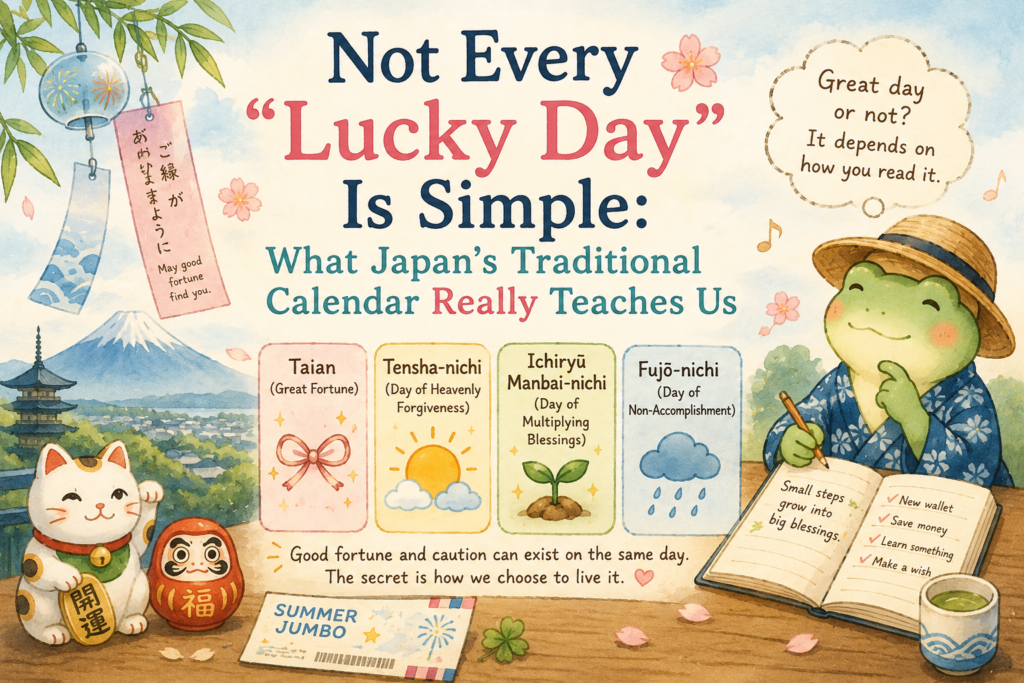
You may have seen headlines like this before:
"Today is the luckiest day of the year."
In Japan, these days often appear when several traditional calendar markers associated with good fortune happen to fall together.
On July 19, 2026, three such auspicious markers coincide: Taian, Tensha-nichi, and Ichiryū Manbai-bi. Because of this, many people choose the day to begin using a new wallet, start a business, or take the first step toward a new goal.
But there is another marker on the calendar that same day.
It is called Fujōju-bi—literally, a day when things are said to be less likely to come to fruition.
At first glance, this seems contradictory.
How can one day be both fortunate and unfavorable?
The answer reveals something beautiful about the Japanese way of looking at time.
Japan's traditional calendar rarely divides days into simply "good" or "bad."
Instead, it layers many different seasonal and cultural rhythms together, inviting us to notice the unique atmosphere of each day.
Life itself is much the same.
Some days feel like a gentle tailwind, carrying us forward with ease.
Others ask us to slow down, reflect, and adjust our course.
The calendar does not try to predict our future.
Rather, it offers quiet hints about the kind of wind that may be blowing.
That is why many Japanese people still enjoy consulting it—not as fortune-telling, but as a small guide for everyday living.
Take the Summer Jumbo Lottery, for example.
Around this time of year, many people buy tickets, hoping that Ichiryū Manbai-bi, often translated as "One Grain, Ten Thousand Times," might symbolize growing prosperity from a small beginning.
Yet on the very same day, Fujōju-bi reminds us not to rush toward expectations.
Instead of thinking, "This is the day I'll become lucky," I prefer another way of seeing it.
Perhaps it is simply a good day to plant a small seed for the future.
You might begin using a new wallet.
Start a savings habit.
Open the first page of a notebook for something you've always wanted to learn.
Write down a new dream.
None of these actions guarantee immediate results.
But every meaningful journey begins with one small step.
Perhaps that is the quiet lesson hidden within these overlapping calendar signs.
Ichiryū Manbai-bi reminds us that even a single seed can grow into something abundant.
Fujōju-bi gently whispers that growth takes patience, and that not every seed sprouts overnight.
I have come to think of Japan's traditional calendar as something like a compass.
It does not decide our destination.
It simply helps us notice the direction of the wind.
Instead of searching for the perfect day, perhaps we can learn to move with the day we have.
That quiet way of living may be one of the reasons Japan's old calendar continues to find a place in everyday life, even today.